Showing posts with label laser land leveling. Show all posts

Friday, June 11, 2021

IRRI and Philippine Agriculture Department mark successful completion of collaborative laser land leveling project


The International Rice Research Institute (IRRI) and the Department of Agriculture-Bureau of Agricultural and Fisheries Engineering (DA-BAFE) will mark the successful completion of their collaborative project “Laser land leveling (LLL) for land use efficiency in the Philippines” during the 8th anniversary celebration of DA-BAFE.

Thursday, November 26, 2020

IRRI and BAFE hold the first of a series of virtual training on laser land leveling


Rice production in the Philippines is constantly faced with threats to food security due to climate change and the COVID-19 pandemic. One of the major challenges to Philippine agriculture is the practice of unsustainable land management such as inadequately leveled fields. An improperly leveled field causes uneven water distribution that leads to poor crop establishment and the inefficient use of seed, water, fertilizer, and pesticides. However, this can be addressed by using laser land leveling technology.

Monday, June 22, 2020

Laser-guided land leveling ramps up in Isabela

Engr. Eddie Rodriquez explaining to the farmers the procedure of LLL

Isabela is the second biggest rice producer in the Philippines and one of the country’s highly mechanized provinces in rice production. With the threat to food security due to the COVID-19 pandemic, mechanization will take an even bigger role in ensuring that the country will have enough food.

Tuesday, July 2, 2019

IRRI leads the first roundtable discussion on laser-assisted land leveling in the Philippines


IRRI and the Philippines’ Department of Agriculture (DA) increases the profitability and sustainability of rice production by utilizing appropriate mechanization as enshrined in the country’s rice roadmap. 

With this, IRRI, the DA, with other rice industry stakeholders in the Philippines convened to share progress, discuss issues, and craft strategies in promoting laser leveling technologies.

Jon Hellin, leader of Sustainable Impact Platform, said that  “Laser Land Leveling was developed in the late 1990s and is a nice example of a technology development leading to considerable field operations efficiency, and towards environmental and financial sustainability. One of the reasons for this roundtable is to discuss how to scale the laser land leveling technology, share experiences from different agroecologies, farmer typologies, different methods, and approaches to scaling.” He also emphasized the importance of partnerships that will help accelerate the access to technologies.

Thursday, June 6, 2019

Thailand gears up innovations on land leveling


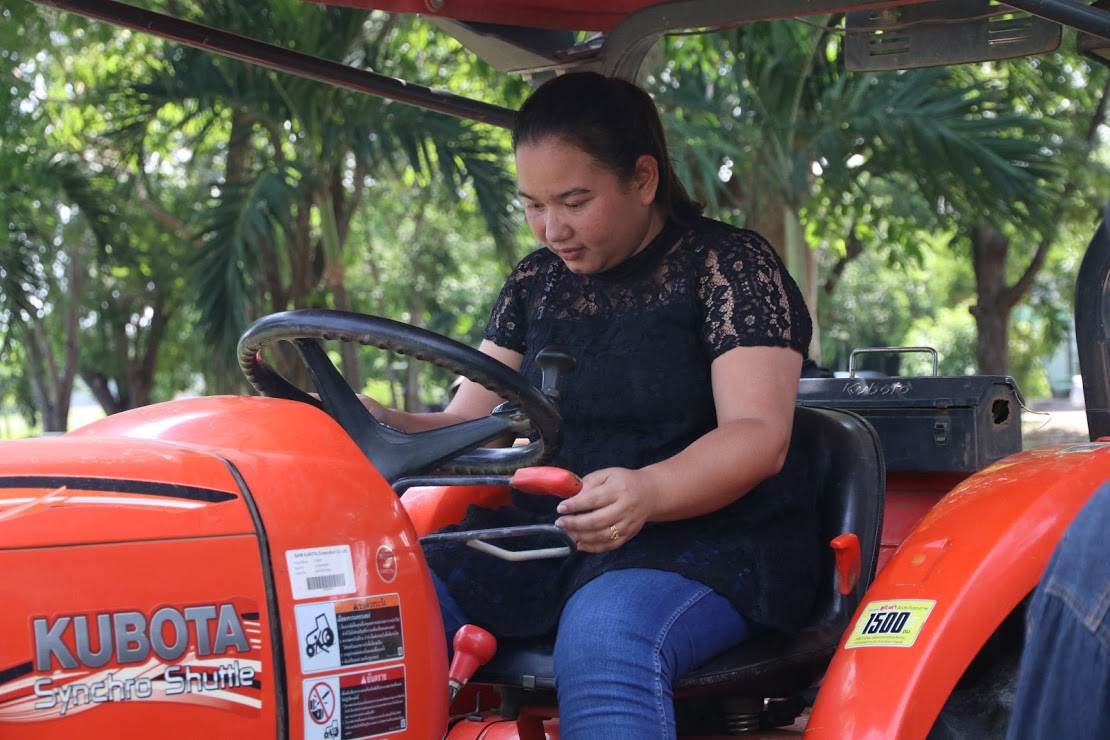
Proper use of the laser-guided land leveling system entails correct and safe tractor operation
The Phraojen Village is one of the rice-producing areas in Chainat province that needs more water during dry season. “Although we have adequate supply of water through the Chao Phraya River, we don’t have enough during the dry season so we need to take measures,” said Winai Jaengan, village head.

To overcome this challenge, the village members rely on underground irrigation during the dry season. “This is costly for us because it needs more fuel to pump the water out.   Additionally, the farmers use small walking tractors which takes time and more cost to level the field,” he added.

The Thai Rice Department, in partnership with IRRI through the CORIGAP project has introduced innovations in rice production. One of these innovations is the laser-guided land leveling.

Monday, June 5, 2017

In Indonesia: Laser leveling of farmland steps up agricultural production


Participants in the laser leveling demonstration learn the basic principles of the technology and how to operate the equipment. IRRI’s CORIGAP project supports capacity building of NARES partners and other rice-farming sectors, such as youth, to accelerate adoption of best management practices that will support Indonesia’s national goal to achieve rice self–sufficiency.

The swampy land areas of South Sumatera, Palembang are poised to become the next rice granary in Indonesia. Recently, to step up the region’s agricultural productivity, local extension professionals, farmers, and students were trained on the use of laser-assisted land leveling and tractor driving in Palembang.

Wednesday, May 24, 2017

Trimble donates laser leveling equipment for IRRI projects in Myanmar


A partnership with Trimble, a company that supplies farming solutions, has been helping the International Rice Research Institute (IRRI) sustain the work to help farmers through promotion and adoption of the laser-assisted land-leveling technology.

Trimble has been a partner in the distribution of high-quality equipment as well as provision of equipment for demonstration and capacity building, and offers a reliable support service.

Just recently, Trimble donated brand-new laser equipment for use in IRRI projects in Myanmar. The donation was facilitated by IRRI’s Postharvest and Mechanization Unit as a result of discussions held during AGRITECHNICA Asia in Bangkok in March 2017. The equipment will be used for adaptive research in laser leveling and for field demonstrations under the Closing Rice Yield Gaps in Asia (CORIGAP) and MyRice projects.

Thursday, March 30, 2017

Myanmar farmers, extension agents join workshop on mechanized land leveling to boost agricultural development

Farmers from four townships covered by MyRice and CORIGAP projects attended the workshop on laser land leveling. They also shared the current best management practices they are trying out in their farms during a Learning Alliance meeting.

MAUBIN, Myanmar—The Ayeyarwaddy Delta, the rice bowl of Myanmar, is endowed with vast land and water resources. However, traditional practices prevent smallholder farmers from achieving optimal rice yields. Increasing farmers’ incomes and productivity require technological innovations such as laser land leveling.

“The precision land leveling using laser-guided system is a technology option that provides a more even land surface resulting in improved crop productivity through reduced irrigation water, chemical input, and more uniform crop growth,” said Engr. Caling Balingbing, an agricultural engineer from the Postharvest and Mechanization Unit at the International Rice Research Institute (IRRI).

Balingbing was one of the experts tapped for a laser land leveling demonstration in Maubin on 23 March.  About 60 farmers, extension agents, and private sector and non-government organization personnel from Daik-U, Hlegu, Maubin, and Letpadan Townships participated in the demonstration as an option for better crop management.  The activity is part of the Learning Alliance, which brings varied stakeholders with similar interests to assess and develop ways to optimize the use of rice-based technologies and practices.

“This event is a great opportunity to interact with NGOs, the private sector, Department of Agriculture, and farmers from other townships,” said Romeo Labios, IRRI scientist and agronomist in Myanmar. “Taking advantage of the Learning Alliance platform, stakeholders can discuss how these technologies from IRRI can provide efficient use of land and water resources and other farm inputs to increase productivity and get a better income. They can learn from each other’s experiences and interact with our private sector guests how you can use this and other technologies.”

“Just by observing the field, I can immediately see the difference and the benefit of laser-guided land leveling it will bring to my farm,” said U Shwe Toe, a  rice and pulse farmer leader from Maubin. “I want to use this immediately; I hope that we can come up with ways to own these technologies.”

“This is a good initiative that helped farmers understand the benefit of the technology,” said Dr. Myo Aung Kyaw from Pioneer Agrobiz, Inc. “From the discussions, they are really convinced that this technology would really work well on their farms.”

Other IRRI experts at the laser land leveling demonstration were Yan Lin Aung, agricultural engineer, and Su Su San and Hlwan-Oo, assistant scientist and researcher, respectively at the IRRI Myanmar office.

The event was organized by Closing Rice Yield Gaps in Asia with Reduced Environmental Footprints (CORIGAP-PRO) and MyRice project. CORIGAP-PRO  is funded by the Swiss Agency for Development and Cooperation, while MyRice is funded by the Australian Center for International Agricultural Research.

Learn more about IRRI (www.irri.org) or follow us on social media and networks (all links down the right column).