The IRRI South Asia Regional Centre (ISARC) organised a two-day training session for farmers on greenhouse gas (GHG) emissions, water-use efficiency, and soil health measurements in rice-based systems to make rice cultivation sustainable and increase yields and profitability of farmers.
Showing posts with label rice production. Show all posts
Thursday, August 3, 2023
Friday, March 16, 2018
Paving the way for sustainable rice production in Asian countries
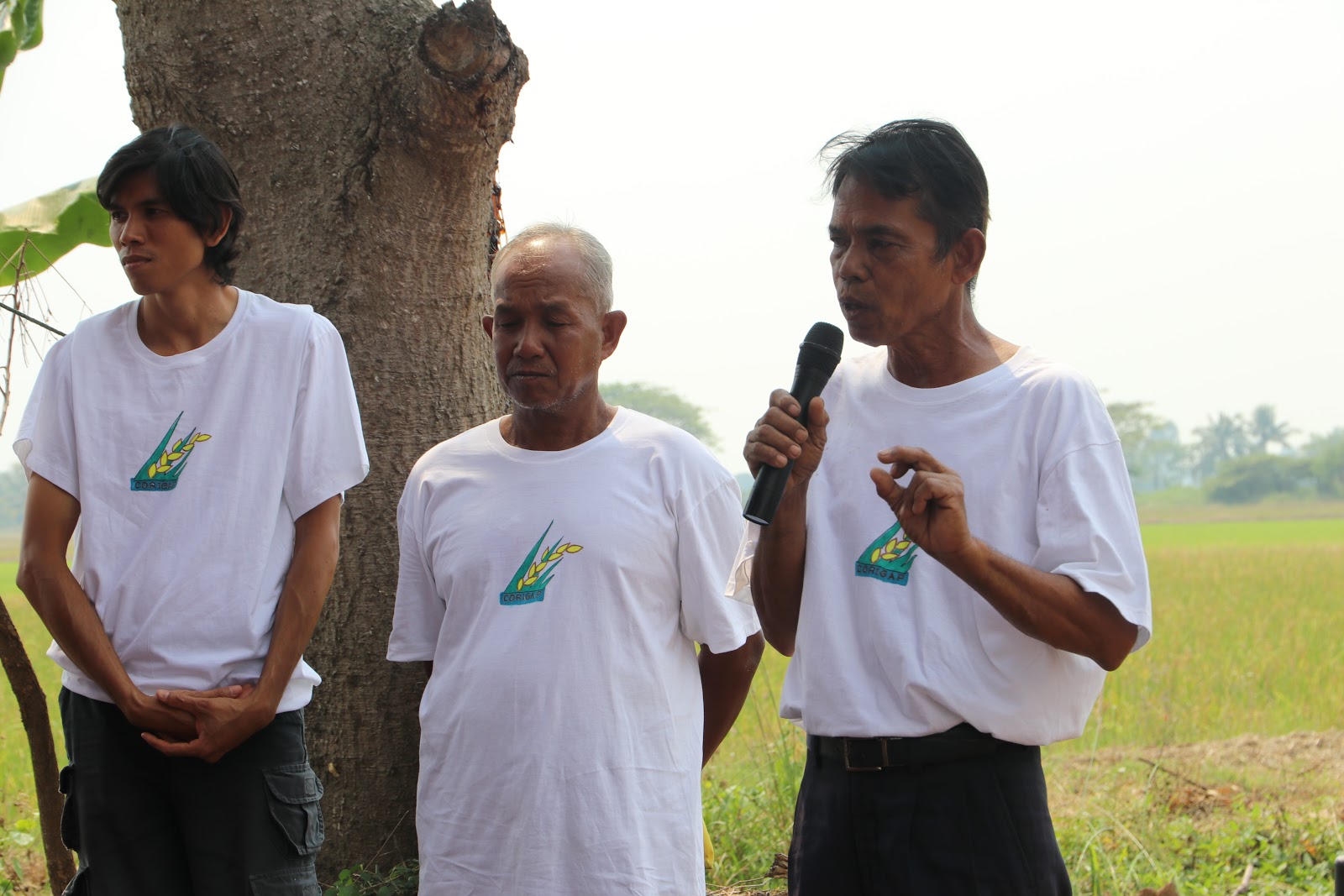
| Farmers from Chainat Province share their experiences about using Laser Leveling. “Before, we experience lodging. After using Laser Leveling, I noticed an improvement in my crops and there was less lodging,” said Mr. Chaleaw Noiseang |
“In 2017, the best management practices promoted by CORIGAP have currently reached more than 375,000 farmers across the six target countries (China, Indonesia, Myanmar, Sri Lanka, Thailand, and Vietnam), with yield increase ranging from 14 to 30%,” according to Grant Singleton, IRRI Principal Scientist and CORIGAP project coordinator. “With this exciting outcome, we will hear how each country has progressed and their plans for future initiatives to take us closer to our target in 2020 of reaching 500,000 farmers,” he added.
Labels:
annual meeting,
CORIGAP,
IRRI,
irrigation,
rice,
rice production,
SDC,
sustainable rice,
Thailand
Thursday, February 22, 2018
Farmer-buyer collaboration can help increase farm productivity in Nepal
Contract farming , a conditional arrangement on inputs and/or output between farmers and buyers, could increase rice farm productivity in Nepal by 7%, according to a recent study by agricultural economists published in Wiley Periodicals.
Research results indicated that the rice yield gap between contract and independent (non-contract) farmers is significant at 13%, which could partly be attributed to contract farming. Findings indicated that participation in contract farming increased the average farm productivity levels of paddy seed farmers from 87% to 94%.
Labels:
agriculture,
contract farming,
cropping,
farming,
Nepal,
rice,
rice production,
seed production
Monday, February 19, 2018
IRRI and Renewable Energy for Rural Areas’ partnership in Nepal introduces solar bubble dryer to address farmers’ problem in paddy drying
The collaboration between International Rice Research Institute (IRRI) and Renewable Energy for Rural Areas (RERA) programme in Nepal was initiated to provide farmers with the tools to effectively dry rice during the spring. It is a project born through the partnership of the Government of Nepal and the Government of Germany to support the decentralized renewable energy sector in Nepal. It is jointly implemented by the Alternative Energy Promotion Centre (AEPC) and Deutsche Gesellschaft für Internationale Zusammenarbeit (GIZ) GmbH on behalf of the German Federal Ministry for Economic Cooperation and Development (BMZ). Amongst other measures, the RERA programme is supporting the development and deployment of new and innovative renewable energy technologies (RETs) in the agriculture sector to increase productivity, generate income and stimulate low carbon economic growth.
Labels:
agriculture,
economic growth,
GrainPro,
IRRI,
low carbon,
Nepal,
paddy drying,
postharvest,
renewable energy,
rice production,
solar bubble dryer
Friday, January 26, 2018
World Bank-funded IRRI project launched in Assam, India to raise farmers’ productivity and income
The World Bank, together with the Government of Assam, launched the Assam Agribusiness and Rural Transformation (APART) project. It is a seven-year program that brings together technical knowledge of eight state departments and six renowned international organizations including the International Rice Research Institute (IRRI).
Monday, January 16, 2017
Namibia eyes building ties with IRRI to boost its rice production
Commissioner Mutelo (third from right) looks forward to a potential partnership between IRRI and the University of Namibia to train its MS and PhD agriculture students. Also in photo (from right): Consul William Co, consulate of the Republic of Namibia, Rector Mutelo; IRRI’s external relations head Corinta Guerta; IRRI partnerships office head Michelle Weldon; and Heritha Nankole Muyoba.
LOS BAÑOS, Philippines—Although corn is Namibia's primary food staple, the government is keen on expanding rice production to improve its food security. Research has shown that the crop can be successfully grown in Namibia's seasonal wetlands. But frequent droughts that occur in the semi-arid country pose a threat to its rice production.
A delegation from Namibia, headed by High Commissioner Anne Namakau Mutelo, visited, the International Rice Research Institute (IRRI) on 12 January to learn about its high-impact research activities, particularly on drought.
"We've learned a lot," said Commissioner Mutelo. "We saw how different countries, nationalities have come together here to conserve rice, improve its production, and generally ensure global food security."
Rector Mutelo, chief executive officer of Namibia Biometric Systems, commended IRRI’s partnership-driven research. "This is the United Nations of rice," he noted.
Heritha Nankole Muyoba of RMZ Consulting, a private educational and business organization in Namibia that works with farmers, said what IRRI offers Namibian farmers are drought-tolerant and climate change-ready rice varieties.
Nakole also showed great interest in the International Rice Genebank. "We saw how all the rice varieties are being conserved and how the their database system is maintained,” she said. “If we start a genebank in Namibia we don't have to start from nothing.”
The Namibian visit also served as an opportunity to explore possible areas of collaboration with IRRI.
"We are planning to start with a memorandum of agreement that links the University of Namibia with your institution so we can train our MS and PhD students as well as build the capacity of our agricultural personnel," said Commissioner Mutelo.
Learn more about IRRI (www.irri.org) or follow us on social media and networks (all links down the right column).
Thursday, December 15, 2016
Vietnam contract farming firm partners with IRRI to achieve sustainable rice production
![]() |
| An agreement between Loc Troi, IFC, and IRRI signed during the SRP Annual Plenary Meeting in Vietnam seeks to produce sustainably certified rice. |
LOS BAÑOS, Philippines—About 4,000 Vietnamese farmers are expected to be compliant with the global standard for sustainable and more efficient rice cultivation by the end of 2018. This is the goal of an agreement between the Loc Troi Group, the International Finance Corporation, and the International Rice Research Institute (IRRI) signed on 7 December.
"Specializing in contract farming, Loc Troi wants to be among the first companies to produce sustainably certified rice," said Dr. Sarah Beebout, an IRRI scientist involved with the Sustainable Rice Platform (SRP).
SRP is a global alliance of agricultural research institutions, agri-food businesses, public sector and civil society organizations convened by the United Nations Environment Programme and IRRI to develop innovative solutions to critical sustainability challenges facing the global rice sector. The SRP Standard for Sustainable Rice Cultivation uses environmental and socio-economic benchmarks to maintain yields for rice smallholders, reduce the environmental footprint of rice cultivation, and meet consumer needs for food safety and quality.
"As Loc Troi ramps up its production for export, it sees the environmental issues as important," Beebout said. "We don't have a final answer yet on how high you have to score in each of the indicators to get certification—that's still in process—but the company is already getting in on the front to show it can make steady improvements in each of the benchmark areas."
Farmers can be encouraged to follow the SRP standards because one of its indicators is profitability. "We're coming from the assumption that farmers aren't going to do anything that decreases their profitability for the sake of anything else," explained Beebout. "So the question is can we increase the other indicators while keeping profitability high?"
From December 2015 to April 2016, 50 farmers each from Dong Thap, An Giang, and Kien Giang in Vietnam’s Mekong Delta initiated the first season’s pilot testing of SRP Standards. Technical support and training was provided by Mr. Joel Janiya, IRRI extension agronomist. The pilot test will run for another season to complete the validation but the farmers decided to continue implementing the SRP Standard to produce “safe” rice.
For the next two years, Beebout and other IRRI scientists will visit project sites in the Mekong Delta to support Loc Troi’s technicians and participating farmers on the proper implementation of the Standard for Sustainable Rice Cultivation. Aside from the technical support, the institute will also help Loc Troi's extension system set up a training program for the 4,000 farmers through IRRI Education.
Learn more about IRRI (www.irri.org) or follow us on social media and networks (all links down the right column).
Thursday, October 13, 2016
Rice blast, a continued threat to global food security
MANILA, Philippines— "Rice blast plays a major reason for the loss of production of rice grain. That loss of rice production feeds into poverty and hunger issues," stated Director General Matthew Morell of the International Rice Research (IRRI). “The topic of rice blast fits with IRRI’s mission of securing rice supplies.” Morell made the comments in a pre-recorded welcome to participants of the 7th International Rice Blast Conference held in Manila, 9-13 October.
“So, the work that we’re doing to assure stable and growing rice production is critical to the overall food security of the world,” said Zeigler. “That’s something we should never forget.”
He added that the situation is going to continue for the foreseeable future. “The demand for rice is going to increase in the coming decades—certainly during my lifetime as well as in the lifetimes of every person in this room,” Zeigler emphasized. “And that increase will further be threatened by rice blast unless we do something about it.”
Zeigler, one of the world’s leading plant pathologists, admitted that he once was captivated by this fungus pathogen early on as a graduate student. “It is very, very difficult to get our hands around rice blast despite the excellent efforts to completely manage the rice crop. This interesting and complex disease never ceases to surprise us.”
Zeigler urged the participants to pay attention to climate change. “We must work with our crop modelers to try to predict where climate might exacerbate future problems with the fungus. Changes in management practices will be critical in determining remedies for decades to come.”
| The conference was an opportunity for experts from all over the world to discuss scientific innovations in managing one of the biggest threats to rice production and food security. |
“It is amazing to see a community come together and reconnect right away because of a common passion,” said Dr. Hei Leung, head of IRRI’s Genetics and Biotechnology Division and conference chair. “This conference has been a great opportunity for each one of us to learn and respect each other’s achievements—I think that’s the driving force of the rice blast community. It’s functioning as a community of practice.”
The conference also featured the soft launch of the online resource, Rice diseases: their biology and selected management practices. Featured online, for now, are the Preface and Introduction (The Future Impact of Rice Diseases by Zeigler and Leung) and the full section on rice blast. The latest information on around 70 more rice diseases will be placed online as it becomes available from the technical editors.
Participants spent the last day of the conference visiting IRRI headquarters to meet with relevant rice scientists and learn about IRRI’s work on rice blast.
IRRI's work on disease and pest-resistance rice
Photos
Labels:
global food security,
Hei Leung,
Matthew Morell,
rice blast,
rice production,
Robert Zeigler
Friday, September 11, 2015
Philippines: Ecological engineering in rice production proven to bring tangible benefits for farmers
![]() |
| Native stingless bees pollinate sunflowers at an ecologically engineered site in Rizal. |
Subscribe to:
Posts (Atom)