The Cereal Systems Initiative for South Asia (CSISA) and Division of Agricultural Extension, Indian Council of Agricultural Research (ICAR) jointly convened the KVK-CSISA network annual workshop at the NASC Complex, New Delhi on September 23. In the workshop, policymakers, scientists, and experts from the Indian Council of Agricultural Research (ICAR), Department of Agricultural Research and Education (DARE), Krishi Vigyan Kendras (KVKs), International Institute of Tropical Agriculture (IITA), International Maize and Wheat Improvement Center (CIMMYT), International Rice Research Institute (IRRI), International Food Policy Research Institute (IFPRI), and Department of Mission Shakti, Government of Odisha discussed and reviewed the KVK-CSISA activities and planned landscape diagnostic survey (LDS) activities for pulses and oilseeds in rice-pulse/rice-oilseed cropping system across India under the network.
Showing posts with label CSISA. Show all posts
Wednesday, September 28, 2022
Wednesday, June 8, 2022
Bayer Delegation visits ISARC
Varanasi, 22 May - A delegation from Bayer Crop Science led by Dr. Amit Trikha, Global Crop Strategy Lead, and Dr. Sangeeta Mendiratta, Lead Government Affairs met with the IRRI team at IRRI South Asia Regional Centre (ISARC), Varanasi.
Location:
Varanasi, Uttar Pradesh, India
Monday, April 22, 2019
IRRI joins regional discussion on mechanization of grain harvesting
![]() |
| Demonstration of a wheat combine in Bhairahawa district, Terai Region, Nepal. |
IRRI’s Mechanization and Postharvest Cluster participated in a traveling seminar on Mechanized Grain Harvesting for Smallholder Farmers in Nepal and Asia in Nepal on 25-29 March 2019 .
The event aimed to identify mechanization research and learning areas across South and Southeast Asia, particularly Nepal, India, and Bangladesh. The traveling seminar included field visits and a workshop on farmers’ grain wheat harvesting, interactions with various distributors, service providers and operators of emerging technologies on rice harvesting at Nepal’s Terai Region.
Dr. Timothy Krupnik, Lead of CSISA Bangladesh, said that CSISA is addressing challenges in smallholder farmers’ productivity and that the traveling seminar is an avenue to stimulate ideas for collaborative research around markets and market system on appropriate mechanization.
Labels:
CSISA,
grain harvesting,
IRRI,
mechanization,
Nepal
Friday, August 11, 2017
India: Season-long training on rice cultivation under way in Odisha
Organized by Krishi Vigyan Kendra (KVK)-Bhadrak of Orissa University of Agriculture and Technology (Bhubaneswar, Odisha, India) in collaboration with Cereal Systems Initiative in South Asia (CSISA), the program is composed of five training days for each session, which are covering each phase of rice cultivation. The other four sessions are tackling rice transplanting, weed management, pest and disease management, and harvesting.
Twenty village agricultural workers from the Department
of Agriculture participated during the first training day. They were grouped into
five, each of which was assigned a plot at the KVK experimental farm. This scenario allows them to conduct trials throughout the training period.
Dr. Aurovinda Das, senior scientist and program coordinator of KVK-Bhadrak, explained the objectives of the training program as well as its relevance in Bhadrak, Odisha. Scientists from CSISA and KVK discussed the technical aspects of the program and demonstrated the actual mat nursery preparation in the field.
Instructional leaflets containing guidelines on mat-type
nursery management, manual transplanting, and best bet agronomy were
distributed among trainees. All participants are expected to further train
farmers, dealers, and members of NGOs in mat-type
nursery management in Odisha, India.
Establishing a modified mat nursery is the most popular training video that IRRI has ever produced with nearly 310,000 views.
Authors: Aurovinda Das, Debashis Nayak, Vivek Kumar, Panneerselvam Peramaiyan, and Ashok Kumar
~~~Establishing a modified mat nursery is the most popular training video that IRRI has ever produced with nearly 310,000 views.
Authors: Aurovinda Das, Debashis Nayak, Vivek Kumar, Panneerselvam Peramaiyan, and Ashok Kumar
Learn more about IRRI (www.irri.org) or follow us on social media and networks (all links down the right column).
Labels:
Ashok Kumar,
CSISA,
Debashis Nayak,
Krishi Vigyan Kendra,
Odisha,
Panneerselvam Peramaiyan,
urovinda Das,
Vivek Kumar
Tuesday, October 9, 2012
Bangladesh: Farmers field day held on short-duration rice variety
A Farmers’ Field Day on BRRI dhan56, an early-maturing and short-duration variety, was held at Rajarhat in Kurigram District on 26 September 2012.
Seventy-three farmers came and exchanged practical tips and shared experiences with one another. It is noteworthy that no other rice variety matured in September in the area.
Bangladesh: CSISA participates in agronomy conference
The Cereal Systems Initiative for South Asia in Bangladesh (CSISA-BD) took part in the 11th International Conference of the Bangladesh Society of Agronomy on 6 October 2012. The theme of the conference was Advances in agronomic research under changing environment in Bangladesh.
Tuesday, September 18, 2012
Nepal: Training on rice-based farming systems held in Kathmandu
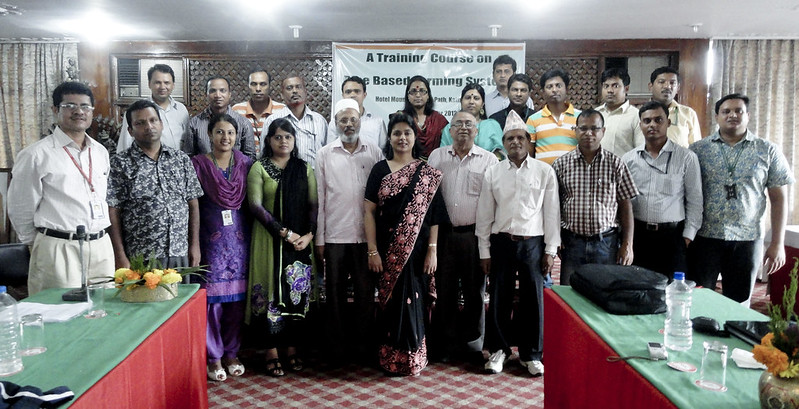
Twenty IRRI staff attended Rice-based farming systems, a 5-day (10-14 September 2012) training program held in Kathmandu. The program sought to familiarize participants with rice-based farming under different ecosystems in Nepal and Bangladesh. Rice, the staple food of the Nepalese people, is grown in various physiographic conditions, from the terai (plains) to areas of about 3,000 feet above sea level.
Wednesday, August 8, 2012
Bangladesh: Farmers use too much fertilizer, research says
A farmers’ participatory research in Bangladesh on site-specific nutrient management found that farmers use more fertilizer than necessary, resulting in added costs but not necessarily better production.
It established that farmers use more fertilizer than recommended by the BRRI and soil tests. The excess fertilizer costs an extra BDT 5025 per hectare, but is not resulting in more profit.
The findings were based on crop seasons aman 2011 and boro 2012. Also based on these two seasons, the farmers drew 'fertility maps' on which they determined optimum fertilizer use for various soil fertility gradients in each village. The farmers will also use the results of the next aman and boro seasons to further evaluate the practice.
The results of the participatory research, conducted in 65 farmers’ plots at 11 villages in the Jessore Sadar, Monirampur, Jhenaidah Sadar, and Kaligonj upazilas, was consolidated in two workshops held recently.
The study was conducted under the Cereal Systems Initiative for South Asia project in Bangladesh (CSISA-BD), funded by USAID. It aimed to motivate farmers to use optimum fertilizer in rice production.
M.A. Mannan, additional director for the Jessore Region, commented on the approach being a good way to reduce fertilizer cost and requested its dissemination to other farmers and extension workers via the CSISA-Bangladesh project.
The workshops were held on 23 and 26 July in Jhenaidah and Jessore districts, respectively, with 69 farmer-researchers attending.
These were facilitated by A.K.M. Ferdous, cropping systems specialist; Ireen Sultana, agriculture development officer; and Md. Zahirul Islam and Md. Mozaharul Islam of the CSISA-Bangladesh project.
Learn more about IRRI (www.irri.org) or follow us on the social media and networks (all links down the right column).
Tuesday, July 31, 2012
Bangladesh: Farmers choose BRRI dhan48 as best aus rice variety
![]() |
| Farmers from Stkhira District in Bangladesh say aye for BRRI dhan48, a new variety recommended for cultivation in the aus rice season. |
Ninety farmers from six villages in the Stkhira District of Bangladesh chose BRRI dhan48 as the best aus rice variety after going on a motivational tour and participatory evaluation of aus rice varieties on 18 July 2012.
BRRI dhan48 matures about 10-15 days earlier than Jamaibabu, a variety of Indian origin, and BR26—varieties that farmers currently use because it allows them timely planting of the succeeding aman rice crop. BRRI dhan48 also has longer panicles with more filled grain and could potentially produce higher yields. The farmers also noted that its plant is strong and stout and, unlike Jamaibabu, is not susceptible to disease.
It was also observed that BRRI dhan48 seems to produce more straw, which also has value to farmers as cattle feed. The participants indicated their interest for securing BRRI dhan48 seeds for cultivating in their respective areas in 2013.
The tour was organized by TMSS, a partner of the Cereal System Initiatives for South Asia project in Bangladesh (CSISA-BD).

Md. Harunur Rashid, cropping system specialist, and Debabrata Mohaldar, agriculture development officer of CSISA-BD's Khulna Hub, facilitated the event.
Bangladesh: IRRI holds rice production course in Barisal
A one-day training session on rice production for local service providers or LSPs was held at the Barisal regional station of Bangladesh Rice Research Institute on 18 July 2012.
LSPs are local folk who own or operate an agricultural support service such as a power tiller, water pump, fertilizer and pesticides dealership, or seed trade. Eighteen of them from Barguna, Barisal, Patuakhali, and Jhalokathi districts attended as participants.
Common and area-specific problems were identified and the corresponding information gaps determined during the training. Problems or concerns identified were: newly developed salt- and submergence-tolerant rice varieties, new season-specific high-yielding varieties for favorable ecosystems, quality seeds and suppliers, seedbed preparation and maintenance, quality seedling production, water management technologies, water pumps, area- and variety-specific fertilizer doses and applicators, pests, and pest management.
The role of LSPs and how they were to support local farmers were also discussed.
IRRI organized the event under the project Cereal Systems Initiative for South Asia (CSISA) in Bangladesh. Md. Shahidul Islam of CSISA-IRRI in Barisal and Md. Harunur Rashid of CSISA-IRRI in Khulna were among the facilitators of the participatory training program.
Tuesday, July 24, 2012
Bangladesh: CSISA holds training workshop on rice technology adoption
A training workshop on rice-based cropping systems and adoption of rice production technology was held in Khulna for rice-related service providers.
The workshop was organized by the Cereal Systems Initiative for South Asia in Bangladesh (CSISA-BD), with the assistance of the Directorate of Agricultural Extension (DAE), and was held on the CSISA-IRRI Khulna Hub premises on 19 July 2012.
Eighteen local service providers from remote areas in 6 upazilas in Khulna, Satkhira, and Bagerhat districts attended as participants. The service they provide include supplying seeds of new high-yielding, salt-tolerant, and other rice varieties, and of other crops; fertilizers; pest and disease management; irrigation; and crop management.
Participants learned to identify information needs of farmers against the type of information provided by them and the technological packages recommended by the NARES and CSISA-BD project for the area. They determined the gap between what is available and what is sought, and discussed ways to overcome this gap.
M.A. Aziz, DAE deputy director in Khulna District, encouraged the participants to provide services appropriate to a community and emphasized the judicious application of fertilizer and other farm inputs.
Tuesday, July 17, 2012
India: Research and delivery stakeholders meet in Odisha
More than 50 representatives from the government, private sector, universities, NGOs, and various other institutions gathered for the Odisha research and delivery hub expert consultation meeting at the Mayfair Convention Center in Bhubaneshwar, India, on 10 July 2012.
Samarendu Mohanty, program leader for policy and targeting and head of IRRI's Social Sciences Division, organized the meeting to finalize planned activities of the hub as part of the Cereal Systems Initiative in South Asia (CSISA) project.
As the project moves into its second phase, plans are in place to expand its activities in the eastern state of Odisha by setting up a research and delivery hub to enable public-private-civil society partnerships for participatory technology development that are relevant and responsive to local conditions and priorities. Inputs from various stakeholders are thus needed to help the CSISA team formulate its work plan in the state.
Represented in the meeting were the Central Rice Research Institute, Directorate of Research on Women in Agriculture, Directorate of Water Management, Orissa University of Agriculture and Technology, BISWA, AID/IRRI Programme, Digital Green, G.B. Pant University of Agriculture and Technology, ICRISAT, ILRI, IFPRI , CIMMYT, CIP, IIT Guwahati, KIIT School of Rural Management, M.S. Swaminathan Research Foundation, Orissa State Seeds Corporation, Ltd., PALLISHREE, PRADAN, PRAGATI, VARRAT, and the IRRI-CSISA team from IRRI headquarters and the India office.
Samarendu Mohanty, program leader for policy and targeting and head of IRRI's Social Sciences Division, organized the meeting to finalize planned activities of the hub as part of the Cereal Systems Initiative in South Asia (CSISA) project.
As the project moves into its second phase, plans are in place to expand its activities in the eastern state of Odisha by setting up a research and delivery hub to enable public-private-civil society partnerships for participatory technology development that are relevant and responsive to local conditions and priorities. Inputs from various stakeholders are thus needed to help the CSISA team formulate its work plan in the state.
Represented in the meeting were the Central Rice Research Institute, Directorate of Research on Women in Agriculture, Directorate of Water Management, Orissa University of Agriculture and Technology, BISWA, AID/IRRI Programme, Digital Green, G.B. Pant University of Agriculture and Technology, ICRISAT, ILRI, IFPRI , CIMMYT, CIP, IIT Guwahati, KIIT School of Rural Management, M.S. Swaminathan Research Foundation, Orissa State Seeds Corporation, Ltd., PALLISHREE, PRADAN, PRAGATI, VARRAT, and the IRRI-CSISA team from IRRI headquarters and the India office.
Subscribe to:
Posts (Atom)