Tuesday, November 8, 2022

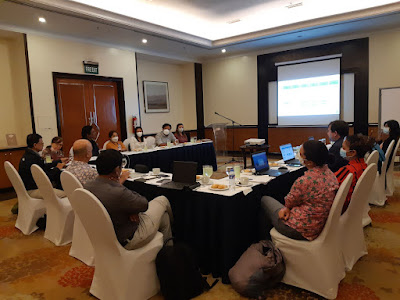
Rice Breeding Innovations team learns about mechanized irrigation system for direct-seeded rice

Amid a climate crisis, it remains a challenge to meet the increasing global demand for rice. Direct-seeded rice (DSR) aims to reduce the environmental impact of rice production by producing rice efficiently with less labor, water, energy, and agrochemicals. It is a major undertaking for the International Rice Research Institute (IRRI).

Friday, November 4, 2022

Strategies for Native Trait Development discussed during the RBI Leadership Team Planning Meeting

>

As part of the efforts to further strengthen IRRI’s breeding team and mission, the Rice Breeding Innovations (RBI) Platform Leadership Team convened to map out strategies for native trait deployment on September 29.

Wednesday, November 2, 2022

Asian Mega-Deltas Initiative builds learning alliance to address climate change issues in the Mekong Delta


To form a learning alliance that has an interest to address climate-related issues in the Mekong Delta of Cambodia, the CGIAR Initiative on Securing the Food Systems of Asian Mega-Deltas for Climate and Livelihood Resilience (AMD) conducted a workshop to build a network of diverse stakeholders in the provinces of Takeo and Prey Veng in Cambodia. 

IRRI relaunches its nematode program to address demands for direct seeded rice

The rice root-knot nematode (RKN), Meloidogyne graminicola, is one of the most destructive species of nematodes causing yield losses ranging  from  28 to 87%.  RKN forms hook-like galls on the roots, and in cases of severe nematode infestation, it results in yellowing and stunting of rice plants.

Several studies suggest that the shift from irrigated rice to water-saving cropping practices, as a response to the decreasing availability of water and agricultural labor, favor RKN. Sustainable management of nematodes in these rice production systems involves the use of resistant or tolerant varieties, control of alternate hosts, crop rotation, and biological control.

Recognizing the increasing importance of RKN, particularly in direct seeded rice (DSR), the International Rice Research Institute (IRRI) is reactivating its research activities in nematology. As part of this effort, research staff of the Sustainable Impact through Rice-Based Systems and Rice Breeding Innovations Platforms attended the Training on Basic Methods for Research on the Rice Root-Knot Nematode on 17-21 October 2022 to learn how to identify RKN based on its morphology and plant symptoms and mass produce and extract RKN from root and soil samples. Participants were also trained on how to standardize the inoculum, and phenotyping methods for screening germplasm for resistance or tolerance to RKN.

Dr. Marita S. Pinili, Senior Plant Virologist and Phytonematologist and Head, Pest Management Division of University of the Philippines Los BaƱos served as the training facilitator, and Dr. Nancy Castilla of IRRI was the coordinator. At the end of the training, the participants presented the results and lessons learned during the practical exercises in the laboratory, greenhouse, and field.

The RKN research activities are important to the IRRI’s DSR project which is seen to be one of the most efficient, sustainable, and economically-viable rice production systems used today. RKN is found in diverse rice ecosystems, but is most destructive in rainfed and upland rice in South and Southeast Asia. It also occurs in North and South America, Europe and Africa.

###

Learn more about IRRI (www.irri.org) or follow us on social media and networks (all links down the right column).

Wednesday, October 26, 2022

Breeding Program Modernization: Empowering NARES to transform breeding in East and South Africa


In East and Southern Africa, rice consumption and demand are increasing at a faster rate than any other crop. Farmers in this region continue to use old varieties that are vulnerable to climate change. The breeders use a conventional pedigree-based varietal development process, which is slow, laborious and generally takes more than a decade to release a new variety.

Saturday, October 22, 2022

IRRI and Government of Odisha facilitate adoption of direct-seeded rice technology through stakeholder convergence along with gender and youth inclusion


The International Rice Research Institute (IRRI) has been intensively working to improve crop production and farmers’ net income in rice-based diversified cropping systems through innovative technologies that are resource-efficient, cost-effective, and resilient to climatic vulnerabilities. 

Monday, October 17, 2022

Get to know an IRRI Scientist: Van Schepler Luu, Lead of Plant Pathology and Host Plant Resistance Group


The daughter of a smallholder farming family in Vietnam, her father dissuaded her from pursuing a career in agriculture, as he thought it was not a path to prosperity. But rather than be discouraged, she took it as a challenge to do her part to change the lives of rice farmers, like her father, for the better. In this in-depth interview with Van, we asked this passionate scientist what drew her to her field of phytopathology, and why she made the life-changing decision to move her family halfway around the world from Germany to the Philippines to become a part of IRRI.